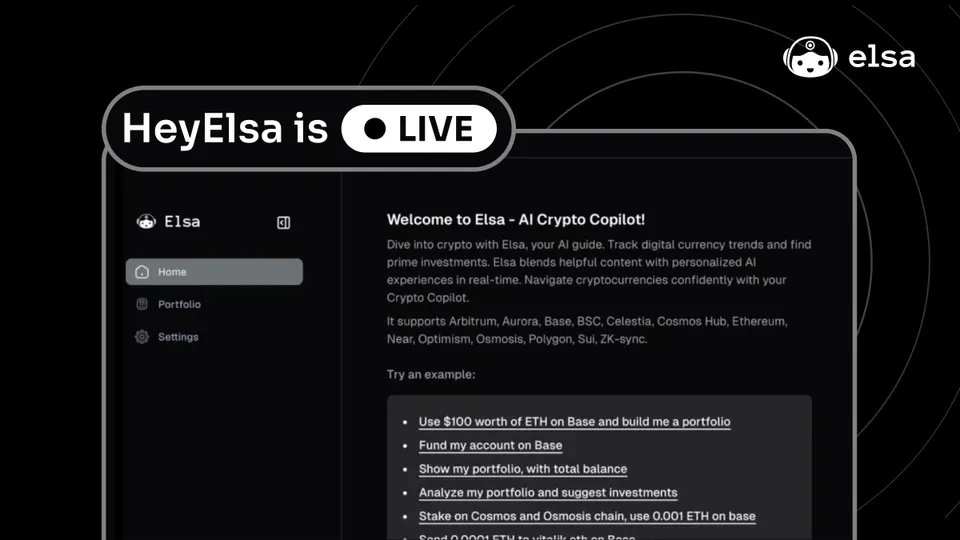
Elsa Overview
TL;DR
Elsa is the crypto agent layer that turns intent → action.
Users (and partners) issue goals; a multi-agent system plans, validates, and executes across chains safely, autonomously, and at scale.
Overview (What is Elsa?)
Elsa makes DeFi feel like typing a message.
Three surfaces, one engine:
- Copilot (B2C): Chat to swap, bridge, stake, hedge, farm, set automations.
- Widget & SDK (B2B): Embed “trade with AI” inside any wallet, dApp, or content app.
- AgentOS: Build/host specialized agents on a shared Agent-to-Agent (A2A) coordination bus.
Overview (What is Elsa?)
Elsa makes DeFi feel like typing a message.
Three surfaces, one engine:
- Copilot (B2C): Chat to swap, bridge, stake, hedge, farm, set automations.
- Widget & SDK (B2B): Embed “trade with AI” inside any wallet, dApp, or content app.
- AgentOS: Build/host specialized agents on a shared Agent-to-Agent (A2A) coordination bus.
What this litepaper covers (Preview)
- Vision → Autonomous DeFi: From on-demand execution to self-driving portfolio actions (take-profit, hedging, rebalancing, APY hopping).
- Multi-LLM Orchestration: Route tasks by complexity/latency to the right model; verified, grounded outputs.
- A2A Communication Layer: Specialized agents coordinate, bid for work, and share context.
- Execution & Safety: Simulation, guardrails, MEV-aware routing, receipts, and proofs.
- Cognitive Cache: Privacy-preserving memory for personalization without leakage.
- Build on Elsa: Agent OS, SDKs, embeddable widget; host your own agents and monetize.
Technical Architecture (Layered)
Bottom → Top
- Data & GroundingOn-chain state (nodes/indexers), oracles, curated KB; freshness checks & anomaly detection.
- Execution LayerPre-audited scripts, simulation, route selection (DEX/bridge meta-routers), MEV-safe submission, idempotency, receipts, telemetry.
- Agent LayerComposable specialists (Swap, Bridge, Yield, Risk/Hedge, Perps, NFT, Sniper, Alerts). First-party + hosted third-party agents with scoped permissions & SLAs.
- A2A Bus (Coordination)Pub/sub messaging, contract-net bidding, plan aggregation, reputation, fairness scheduling.
- Orchestration (Multi-LLM + Planner)Task classification → model routing (small/mid/large). Strategy synthesis, constraint solving, fallback/hedged inference.
- Intent Layer (NL Interface)Parsing, slot-filling, constraint capture, policy hints, multi-turn context & disambiguation.
- Safety & PolicySimulation gates, allow/deny lists, max-notional limits, geo/KYC hooks, verified inference (zkTLS/MPC-TLS).
- Cognitive CacheTEE-backed private memory of preferences, behaviors, outcomes; accelerates planning & personalization.
- ObservabilityTraces, metrics, audit logs, anomaly detection, circuit breakers.
How the three surfaces map onto the stack
- Copilot: Intent → Orchestration → A2A → Agents → Execution(Safety, Cache, Grounding applied throughout)
- Widget & SDK: Partners attach at Intent/Orchestration with their context; reuse the same A2A, Agents, Execution.
- Agent OS: Lives inside Agent/A2A layers; provides SDKs, sandboxing, manifests, reputation, and monetization for hosted agents.
Layers, Policies & Safety
Intent Layer
Role: Natural-language interface that converts user input into machine-readable intents with constraints.
Responsibilities
- Parse NL (text/voice) into structured
Intent{verb, objects[], params{}, constraints{}, riskHint}. - Slot filling (amounts, assets, chains, time horizons, targets) with uncertainty scores.
- Constraint capture: risk limits (max slippage, LTV caps), compliance (geo/KYC), budgets, deadlines.
- Context injection from Cognitive Cache (prefs, past approvals, favorite chains/pools).
Inputs → Outputs
- In: NL prompt, wallet context, session policy, cache profile.
- Out: Validated intent JSON + confidence; missing-slot prompts if needed.
Key Components
- NER + typed entity registry (tokens, chains, protocols).
- Canonical schema & versioning (e.g.,
v3.intent.swap,v2.intent.yield.optimize). - Guardrails (regex, allow-lists, refusal rules for unsafe verbs).
Failure Modes / Handling
- Low confidence → ask clarifying question.
- Ambiguous asset/chain → propose top-3 disambiguations.
- Out-of-policy verb → safe decline with rationale.
Orchestration Layer
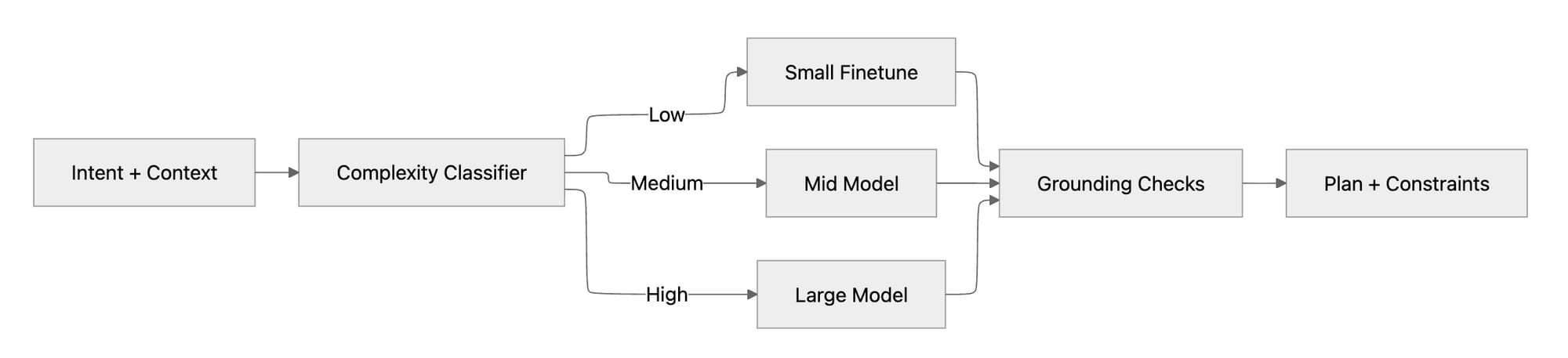
Role: Decides how to satisfy an intent: routes to the right model(s), synthesizes a plan, assigns agents, and sets up A2A messaging.
Responsibilities
- Task classification (complexity, domain, required latency, risk class).
- Multi-LLM routing (small/mid/large or toolformer) with cost/latency budget.
- Plan synthesis: decompose into steps with pre/post-conditions and success metrics.
- Agent assignment & capability matching; create A2A contracts for cooperation.
Inputs → Outputs
- In: Intent JSON, cache profile, live data pointers (oracles/indexers).
- Out:
Plan{steps[], dependencies[], SLAs, fallbackPaths[], evalFns[]}+ agent roster.
Key Components
- Classifier features: task complexity, risk class R0–R3, latency budget, chain/protocol access, wallet approvals needed, MEV exposure, statefulness needs.
- Routing policy (see section below).
- Planner (STRIPS-like) with constraint solver (fees, gas, liquidity, bridge risk).
Failure Modes / Handling
- No feasible plan → return alternatives (cheaper chain, different pool).
- SLA breach predicted → downgrade model, simplify plan, or defer.
A2A Bus (Agent-to-Agent Communication)
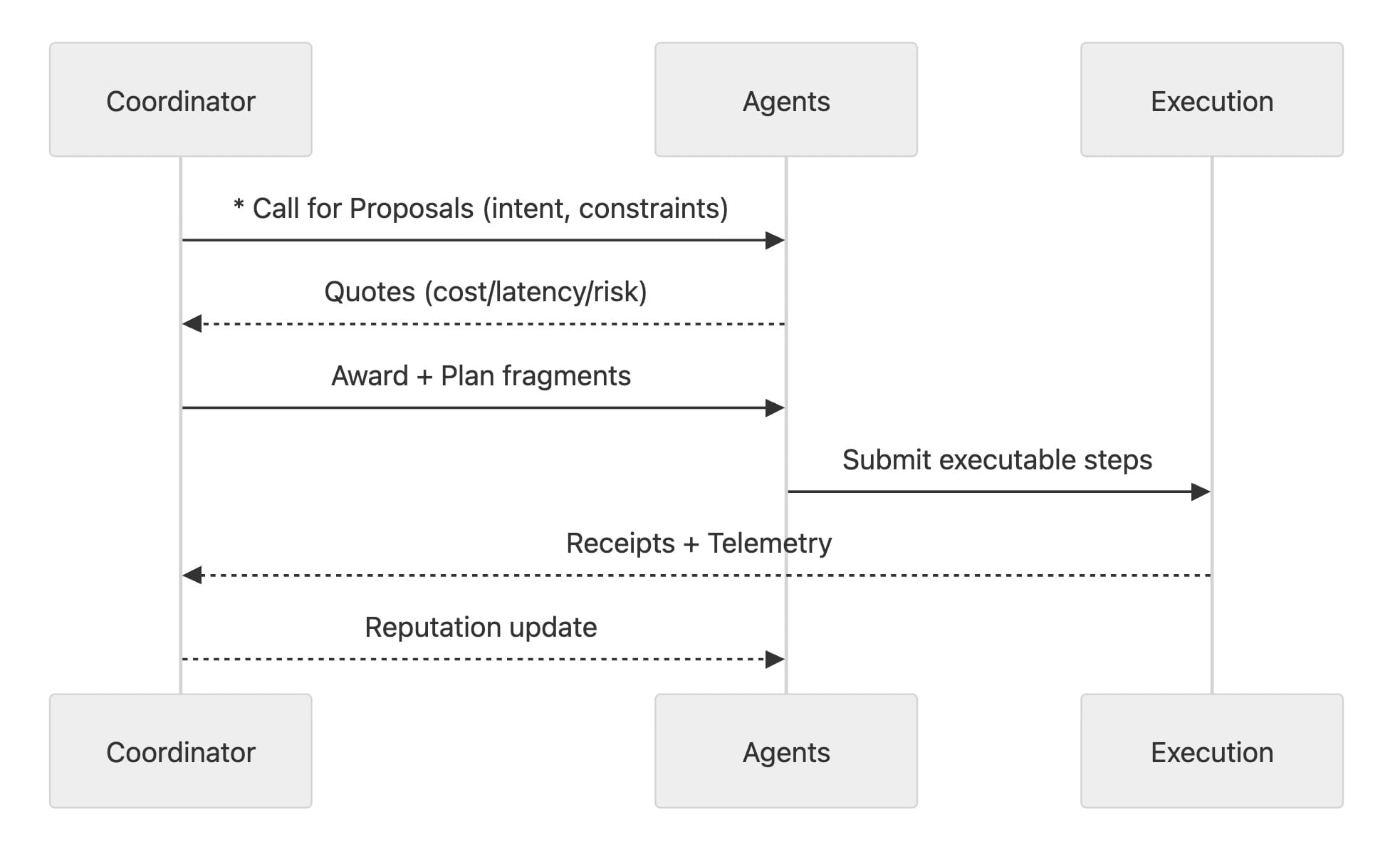
Role: Contract-Net style coordination for multi-agent work; pub/sub plus scheduling and reputation.
Responsibilities
- Matchmaking: broadcast sub-tasks; agents bid/commit with price/SLA.
- Reputation & scheduling: track success, latency, accuracy; prioritize reliable agents.
- Message semantics: idempotent commands, retries, exactly-once task receipts.
Key Components
- Topics:
swap.quote,bridge.route,stake.position,risk.hedge,perps.open,alerts.set. - Message types:
rfq,proposal,award,work.start,work.done,work.fail. - Safety: per-task scopes, least-privilege creds, time-boxed leases.
Agent Layer
Role: Composable specialists that execute parts of a plan.
Core Agents
- Swap Agent: DEX quoting, split routes, slippage control.
- Bridge Agent: Route selection (risk/fee/time), proof checks, stuck-tx recovery.
- Yield Agent: APY scan, IL/risk modeling, auto-compound, vault migrations.
- Risk/Hedge Agent: Perps/options, stop-loss/TP, delta hedging.
- Perps/NFT/Sniper/Alerts: Venue-specific execution, floor sweeps, limit/cancel/IOC, event watchers.
Interfaces
- Capability manifests (supported chains, tokens, max notional, expected latency).
- Deterministic simulation hooks for pre-trade checks.
- Telemetry contract: step outcome, gas used, PnL, confidence, anomalies.
Execution Layer
Role: Turns approved plans into on-chain transactions safely.
Responsibilities
- Pre-audited scripts per protocol (param-bounded).
- Transaction simulation (fork or RPC sim) with revert reason capture.
- Meta-routing: 0x/CoW/UniswapX/1inch; bridge aggregators; batching.
- MEV safety: private relays, back-run protection, non-arb bundle rules.
- Settlement & receipt collation; retries with nonces/gas bumping.
Outputs
ExecutionReport{txids[], status, receipts[], realizedSlippage, fees, proofs}.
Cognitive Cache
Role: Private memory for speed and personalization.
Contents
- Preferences (risk, fee sensitivity, favored chains/pools).
- Behavioral features (time-of-day activity, asset affinities).
- Allowances & trusted protocols.
- Summarized wallet history (positions, cost basis, PnL bands).
Controls
- TTLs & decay, user export/delete, per-scope consent, encryption at rest.
Benefits
- Fewer clarifications, better defaults, faster routing.
Safety Layer
Role: Proves what we know, enforces what we allow.
Grounding
- Live on-chain state (indexers/full nodes), oracles (prices/liquidity), curated KB (audits, risk advisories).
- Every recommendation/check passes
GroundingEngine.validate().
Policy Engine
- Geo/KYC, protocol allow-lists, notional/risk caps, leverage ceilings, counterparty filters.
Verified Inference
- zkTLS / MPC-TLS proof adapters for “this insight came from these sources at time T” without exposing raw logs.
Simulation & Dry-Run
- Pre-execution sims with guard conditions and stop-if rules.
Observability
Role: Make intents→actions traceable and operable.
What’s tracked
- Traces with span IDs from intent parse → plan → A2A → execution → receipts.
- SLAs/SLOs per step (p50/p95 latency, success rate, cost).
- Audit logs for all policy decisions and escalations.
- Anomaly detection (stuck bridge, abnormal slippage, oracle drift).
Surfacing
- Operator dashboards, partner webhooks, user-visible receipts.
Classifier Features (expanded)
- Task complexity: single-step vs multi-leg, cross-chain, approvals required.
- Risk class (R0–R3): read-only → low-risk swap → leveraged/perps → protocol-novel/high-risk.
- Latency budget: sub-second (quotes) to minutes (bridges) vs deferred (rebalances).
- Chain access: wallet approvals, token allowances, supported venues/bridges.
- Market context: volatility, liquidity depth, MEV risk bands.
- User profile: fee sensitivity, risk tolerance, preferred venues.
Routing Policy (multi-LLM)
- Fast / transactional (balances, prices, parameter extraction) → small finetunes (low latency, tool use).
- Analytical (yield comparisons, pathfinding, risk scoring) → mid models with tool-augmented RAG.
- Strategic / autonomous (multi-leg plans, portfolio mgmt, hedging) → large models with planning + constraint solving.
- Cost/latency governors: per-request budgets; degrade gracefully under load.
Grounding Pipeline
- Fetch: on-chain (nodes/indexers), oracles (price/liquidity), curated KB (audits, risk lists).
- Validate: cross-source consistency checks, freshness thresholds, quorum rules.
- Attach: include
groundingRefin every recommendation/action. - Prove: optional zkTLS/MPC-TLS proof artifact for partner/user verification.
Verified Inference
- What: Cryptographic proofs that a model’s answer was derived from stated inputs and logs.
- How: Proxy TLS via zk/MPC adapter; store digest; emit verifiable receipt with the response.
- Where used: High-stakes advice, partner compliance, dispute resolution.
Fallbacks & Hedging
- Model timeouts: reroute to smaller model; summarize; request user confirmation if confidence < threshold.
- Execution hedging: secondary routes/venues; split orders; time-slice in volatile markets.
- Dual-run critical plans: plan via large model, cross-check via mid model; reconcile conflicts.
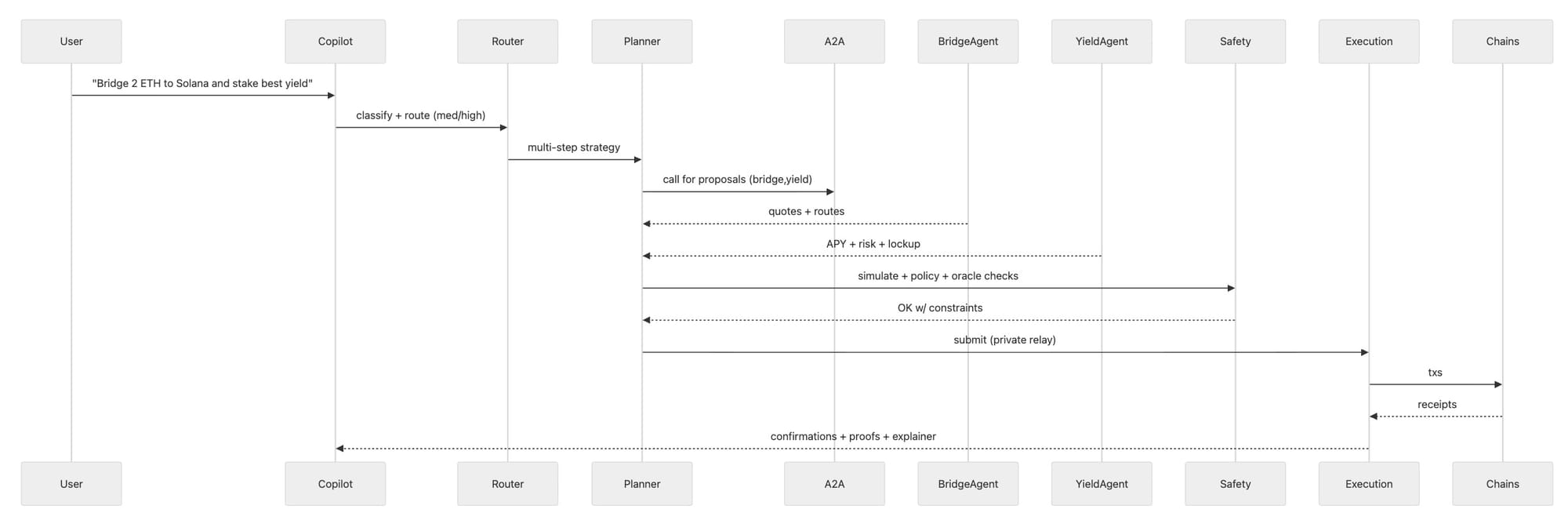
Example Intent → Action (concise)
- User: “Bridge 2 ETH to Solana and stake for safest yield.”
- Intent Layer:
intent.yield.optimizewithamount=2 ETH,dstChain=Solana,risk=low. - Orchestration: classify
R2, route mid/large model → plan: {swap? no, bridge via Wormhole, stake Solana pool A}, SLAs. - A2A Bus: RFQs to Bridge Agent + Yield Agent; award best proposals.
- Execution: simulate bridge + stake; private submit; collect receipts.
- Safety: ground rates/APY; enforce policy caps; attach proof.
- Observability: log trace; show user receipts + realized APY baseline.
- Cache: update prefs (Solana OK, low-risk yield).
Schemas (abridged)
Intent (v3)
{
  "verb": "yield.optimize",
  "objects": [{"asset":"ETH","amount":"2"}],
  "params": {"dstChain":"solana","risk":"low"},
  "constraints": {"maxSlippageBps":50,"deadlineSec":900},
  "profileRef":"cache://user/123",
  "policyScope":"retail.low",
  "version":"v3"
}
Plan (v2)
{
  "steps":[
    {"id":"s1","type":"bridge","route":"wormhole","from":"ethereum","to":"solana"},
    {"id":"s2","type":"stake","venue":"solend","asset":"SOL","policy":"lowRisk"}
  ],
  "dependencies":[["s1","s2"]],
  "sla":{"p95LatencyMs":30000},
  "fallbacks":[{"on":"bridgeFail","route":"portal"}]
}
SLAs / SLOs (suggested)
- Intent parse p95 < 400ms; plan synth p95 < 1.5s (analytical), < 4s (strategic).
- Quote freshness < 3s; simulation success > 99%; execution success > 98% (with retries).
- Max realized slippage ≤ quoted + policy buffer (e.g., +15 bps).
- A2A task award latency p95 < 800ms; agent failure rate < 1% per 1k tasks.
Policy Defaults (retail tier)
- Max leverage 3×; LTV ≤ 60%; single-venue exposure ≤ 40% per action.
- Bridge preference: audited routes; fallback only with user confirm (R3).
- New protocol cool-down: require audit flag or manual review.
If you want, I can convert this into a Notion page export (as Markdown with toggles) or wire it into your existing data room structure.
Build once; get execution + safety + distribution.
- SDKs: TypeScript/Python — intent schemas, on-chain connectors, simulation, policy hooks.
- Lifecycle: register → advertise capabilities → receive tasks → emit plan fragments/quotes/tx payloads → execute → report outcomes.
- Sandbox: per-agent runtime, quotas, scoped permissions (least privilege), secrets isolation.
- Scheduling: capability matching + live load + reputation.
- A2A messaging: pub/sub topics (
quote,plan,risk,exec,status) with signed envelopes.
Agent Manifest (example)
name: yield-agent
version: 1.2.0
capabilities:
  - chain: [base, ethereum, solana]
  - actions: [scan_yield, allocate, compound, exit]
sla: { p95_latency_ms: 1000, success_rate: 0.995 }
cost_model: { pricing: per-plan + per-exec }
permissions: { scopes: [simulation.read, protocols.write:yield, quotes.read] }
Why: multi-specialist coordination for complex workflows.
- Protocol
- Envelope: signed JSON (
msg_id,parent_id,topic,payload,ttl,sig). - Transport: NATS/Kafka-class pub/sub (durable streams), secure WS for interactive co-planning.
- Contract Net: broadcast CFP; agents bid; coordinator selects on price/latency/reputation.
- Consensus: weighted voting on conflicting plans (reputation × recency × scope-fit).
- Idempotency:
(intent_id, step_id).
- Envelope: signed JSON (
- Trust & Reputation
- Metrics: accuracy, timeliness, slippage vs quote, failures, user feedback.
- Decay to favor recency; quarantine/slash malicious or failing agents.
- Pathfinding: 0x / CoWSwap / UniswapX / 1inch meta-routing; bridge selector; order-splitting.
- Simulation: dry-run with pool state; bounds checks (minOut, gas ceiling, deadlines).
- MEV: private relays/bundles; price impact caps; back-run detection.
- Accounts: AA/ERC-4337; session keys; MPC/HW wallet support.
- Risk: dynamic slippage; conditional stops; liquidation buffers.
- Receipts: tx hash, logs, realized slippage, fees, route, quotes vs fills.
- Idempotency: replay-safe by
(user_id, intent_id, step_id).

- Content: prompt history, wallet behaviors (chains, protocols, risk), strategy outcomes.
- Store: vector DB (embeddings) + key/value features.
- Use: disambiguation, defaults, constraint inference, few-shot exemplars.
- Privacy: TEE-backed; per-user scope; opt-in research sharing; differential privacy on aggregates.
Excalidraw brief: circular cache feeding router with “known preferences”, “risk profile”, “recent strategies”.
- Sources: on-chain nodes/indexers; oracles (price/TVL); curated KB (audits/safety).
- Validators: cross-source reconciliation, freshness, anomaly detection.
- Policy engine: denylist, chain allow-lists, max notional, KYC/geo hooks.
- Proofs: zkTLS/MPC-TLS adapters to prove gateway authenticity.
- Explainers: every block/reject returns a human-readable reason.
- Modes: execute now; schedule; autopilot (bounded by policies).
- Features: swaps, bridging, staking, perps (roadmap), copy trading, prediction markets, yield optimizer, sniping/limits, NFT trade & limit.
- Personalization: risk bands, chain prefs, fee sensitivity, favorites.
- Outcomes: ~$100M total volume; 30M+ prompts; higher retention via context.
Widget (drop-in)
- Embed:
<iframe src="<https://app.heyelsa.ai/widget?partner=XYZ&theme=dark>" /> - Prefill context (asset/chain/flow)
- Callbacks:
onQuote,onTx,onError,onComplete
SDK (agents & flows)
- Intent schema, plan API, simulation, submitTx, receipts
- Policy templates, sandbox scopes, quota mgmt
- Theme/tone overrides
import { Elsa } from "@elsa/sdk";

const elsa = new Elsa({ apiKey: process.env.ELSA_KEY });

const intent = {
  type: "yield.optimize",
  amount: "500",
  asset: "USDC",
  constraints: { chain: "base", maxSlippageBps: 30 }
};

const plan = await elsa.plan(intent);
await elsa.simulate(plan.id);
const receipt = await elsa.execute(plan.id);
- Verification: conformance tests (correctness/latency), replay suite, adversarial sims.
- Runtime: CPU/mem quotas, topic rate limits, cost ceilings.
- Monetization: per-plan/per-exec pricing (USDC/$ELSA), rev share on partner volume.
- Metrics: intent→plan→exec funnel, p50/p95, slippage distribution, failure taxonomy, per-agent SLOs.
- Tracing: distributed trace IDs across router/agents/execution.
- Alerts: anomaly detection (slippage spikes, oracle drift), circuit breakers.
- Audit: immutable logs for compliance & partners.
- Wallets: MPC + HW; ERC-4337 AA; session keys with ceilings.
- Exec: allow-list bridges/routers; private flow; expiring quotes; gas caps; reorg-aware confirmations.
- Inference proofs: zkTLS/MPC-TLS verifier endpoints.
- Data privacy: encryption at rest; TEE for cognitive cache; opt-in telemetry.
- Router: p95 < 300ms (low/med), < 900ms (high).
- Plan→Simulate: p95 < 1.2s (single-chain), < 2.5s (cross-chain).
- Quote accuracy: ≥ 99.0% within bounds.
- Execution success: ≥ 99.2% after retries.
- Throughput: 200–500 intents/sec (horizontally scalable).
More users → richer prompts & outcomes → better finetunes → higher plan/exec quality → more partner conversion → more users.

Retail: “Bridge 2 ETH to Solana and stake best yield”
iFrame Widget
- Paste snippet, set partner key, theme/tokens/chains.
- Subscribe to callbacks for analytics/incentives.
SDK
- Install, create intents, plan/simulate/execute, display receipts.
- Apply policy templates (max notional, allow-listed routers, geo limits).
Host Your Agent
- Publish manifest, pass conformance tests, get sandbox scopes.
- Receive A2A tasks; earn per plan/exec.
POST /v1/intents
{
  "type":"swap",
  "user":"0x...",
  "params":{"sell":"ETH","buy":"USDC","amount":"1.0","chain":"base"},
  "constraints":{"maxSlippageBps":30,"deadlineSec":90}
}
GET /v1/plans/{intentId}
# returns steps, quotes, risk, agents, policy gates
POST /v1/execute/{planId}
# returns tx receipts, route, realized slippage, gas
mutation {
  createIntent(input:{
    type: YIELD_ALLOCATE,
    asset: "USDC",
    amount: "500",
    chain: BASE
  }) { id status }
}
- System Layers: rectangle bands for Intent, Orchestration, Agents, Execution; sidecar “Safety”; circle “Cognitive Cache”.
- A2A Market: central “Coordinator” node; multiple Agents bid; arrows for CFP/quotes/award.
- Safety Gates: funnel: Plan → Sim → Policy → MEV → Submit.
- Flywheel: circular loop of Users → Data → Finetune → Quality → Adoption.
Problem
Crypto is powerful but unusable at scale.
- Too many chains, tools, and workflows
- High cognitive load for basic actions
- Manual execution leads to poor outcomes
- Automation exists, but isn’t accessible
Most users don’t need more protocols — they need better execution.
Solution
Elsa introduces an AI-first execution layer.
Users express intent.
Elsa executes it.
- Natural language → onchain actions
- Optimized routing across chains and protocols
- AI agents manage trading, yield, and risk
- Automation without sacrificing control
Elsa abstracts complexity while preserving transparency.
Product Stack
B2C: Elsa Copilot
- Swap, bridge, stake, borrow
- Perpetual trading and copy trading
- Yield optimization and portfolio automation
- Smart alerts and agent-driven execution
B2B: Elsa Infrastructure
- Widget and iframe integrations
- SDKs for apps and wallets
- Agent execution APIs
- Revenue-sharing distribution model
Business Model
Elsa is usage-driven, not speculation-driven.
Revenue sources:
- Transaction fees on execution
- AI agent commissions
- B2B SDK and widget licensing
- Inference and execution fees
As execution volume grows, revenue scales naturally.
Token Overview
| Parameter | Value |
|---|---|
| Token | $ELSA |
| Total Supply | 1,000,000,000 |
| Decimals | 18 |
| Network | Base |
$ELSA is a utility token, powering execution, inference, and access.
Utility of $ELSA
$ELSA is the economic backbone of Elsa.
Fee Discounts
- Reduced execution fees for holders and stakers
Feature Access
- Unlock premium agents (copy trading, sniping, cognitive cache)
Gas Abstraction
- Gas-free transactions within Elsa using $ELSA
Inference & Execution
- AI model inference
- Onchain agent execution
- B2B SDK and widget usage
Utility scales with real platform usage.
Token Allocation & Vesting
| Category | Allocation | Vesting |
|---|---|---|
| Team | 7% | 12m cliff, 24m linear |
| Foundation | 34.490% | 20% TGE, 10m cliff, 24m linear |
| Community | 40% | 20% TGE, 48m linear |
| Pre-Seed | 1.4% | 12m cliff, 24m linear |
| Seed | 9.11% | 12m cliff, 24m linear |
| Liquidity | 8% | 100% at TGE |
Community-first allocation with long-term alignment.
Roadmap Snapshot
Up to Q2 2025 (Completed)
- Public beta live
- Core DeFi Copilot launched
- $1M+ daily volume
- 300K+ MAUs, 700K+ signups
- Monetization enabled
Q3–Q4 2025
- Perpetuals via Hyperliquid
- Copy trading and sniping agents
- Yield vaults and automation
- Mobile apps (iOS & Android)
- Multi-agent orchestration
- $ELSA Token Generation Event
- Token utility activation
2026
- Fully autonomous portfolio management
- Tokenized crypto indices
- Agent Builder SDK
- Automated strategy marketplace
- Cross-chain execution kits
- B2B scale across wallets and apps
Design Philosophy
- Execution > speculation
- Utility before governance
- Demand-backed token economics
- AI that acts, not just advises
Elsa is built for scale, automation, and real usage.